
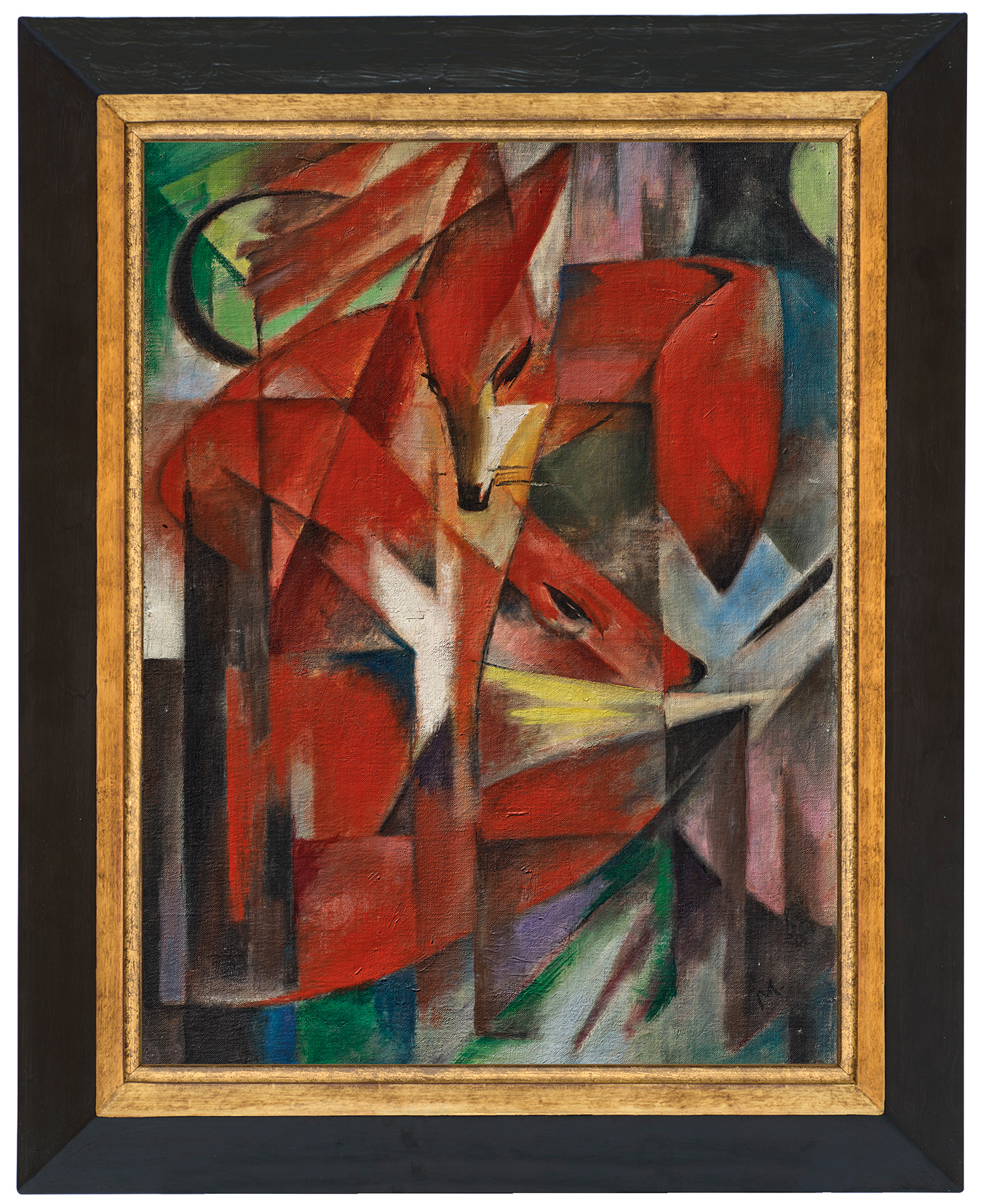
Franz Marc Paintings: Colour, Animals and the Modern World
Franz Marc’s paintings are among the most recognisable works of German Expressionism. Best known for his vivid depictions of animals, Marc used bold colour and simplified forms to explore ideas about nature, spirituality and the changing world around him. His paintings are striking at first glance, yet their colour and composition often carry a deeper symbolic meaning.
Who was Franz Marc?
Franz Marc was born in Munich in 1880 and became a leading figure in the German Expressionist movement. In 1911, he helped establish Der Blaue Reiter (The Blue Rider), an influential group of artists that included Wassily Kandinsky. The group championed artistic freedom and believed that art could express inner or spiritual realities, rather than simply reproduce what the eye could see.
Marc’s career was cut short when he died during the First World War in 1916. Despite his relatively brief working life, he created a distinctive body of work that continues to attract attention for its colour, movement and emotional intensity.
Why did Marc paint animals?
Animals became the central subject of Marc’s art. He painted horses, deer, foxes, cats and other creatures, often placing them in close harmony with their surroundings. For Marc, animals represented an unspoilt way of being, in contrast to what he saw as the alienation and materialism of modern human society.
His animals are not usually presented as portraits in the traditional sense. Instead, their bodies and poses are simplified into powerful shapes that seem to belong to the landscape around them. The result is a world in which creature and environment feel connected, sometimes almost inseparable.
The meaning of colour in Franz Marc’s paintings
Marc used colour expressively rather than realistically. A blue horse or a red deer was not meant to be a literal depiction of an animal’s appearance. Colour helped him convey mood and meaning, giving his subjects a sense of spiritual or emotional presence.
He also associated particular colours with different qualities. In a letter to August Macke, Marc described blue as a masculine, spiritual colour, yellow as a feminine, gentle one, and red as matter that had to be overcome or opposed. These ideas are useful for understanding his approach, although the meaning of colour can vary from painting to painting.
Notable Franz Marc paintings
Blue Horse I (1911) is one of Marc’s best-known works. Its bright blue animal, curved lines and simplified landscape show how he used colour and form to move beyond naturalistic representation. The painting feels calm and dreamlike, with the horse appearing at one with its surroundings.
In The Yellow Cow (1911), a leaping yellow cow stands out against a colourful landscape. The animal’s energetic pose and the sweeping shapes around it give the scene a sense of joyful movement. The painting also demonstrates Marc’s interest in the relationship between animals and nature.
The Tower of Blue Horses (1913) is another celebrated work, although it remains missing. Known through photographs and reproductions, the painting shows a group of blue horses arranged in a monumental, almost visionary composition. Its uncertain fate has added to its place in the story of modern art.
Marc’s later paintings became more fragmented and abstract. In works such as Fighting Forms (1914), angular shapes and clashing colours suggest tension and conflict. This change reflects both his artistic development and the growing anxiety of the period before the First World War.
A lasting influence
Franz Marc’s paintings remain popular because they combine immediate visual appeal with a distinctive artistic vision. Their brilliant colours and stylised animals are easy to recognise, while their themes invite further thought. Marc sought to imagine a more harmonious relationship between living creatures and the natural world—a concern that continues to resonate with viewers today.
Exploring Franz Marc’s Art: 9 Tips for Understanding His Paintings
- Look for animals, a recurring subject in Marc’s paintings.
- Notice how bold colours shape the mood.
- Compare the calm blues in *Blue Horse I*.
- Watch for simplified, angular forms.
- See how animals blend into their surroundings.
- Explore the contrast between warm and cool colours.
- Remember Marc was part of the German Expressionist movement.
- Compare his earlier naturalistic works with later abstractions.
- Consider how his paintings express harmony between nature and animals.
Look for animals, a recurring subject in Marc’s paintings.
When looking at Franz Marc’s paintings, start by noticing the animals. Horses, deer, foxes and other creatures appear throughout his work, often shown in close harmony with the landscape. Rather than aiming for realistic portraits, Marc simplified their forms and used expressive colour to suggest their character and mood. Seeing how each animal relates to its surroundings can help reveal the painting’s sense of movement, emotion and connection with nature.
Notice how bold colours shape the mood.
When looking at Franz Marc’s paintings, notice how boldly he uses colour to shape the mood. His vivid blues, yellows and reds do more than describe animals and landscapes: they can suggest calm, energy, warmth or tension. Rather than matching the colours found in nature, Marc chose them to express feeling and create a sense of harmony—or contrast—between his subjects and their surroundings.
Compare the calm blues in *Blue Horse I*.
Compare the calm blues in Franz Marc’s Blue Horse I with the warmer colours surrounding the horse. The contrast helps the blue figure feel serene and otherworldly, while the flowing shapes bring the animal and landscape together. Notice how Marc uses colour to suggest mood rather than simply reproduce what he sees.
Watch for simplified, angular forms.
When looking at Franz Marc’s paintings, notice how he reduces animals and landscapes to simplified, angular forms. Rather than copying every detail, he builds each subject from bold shapes and sweeping lines, creating a sense of movement and structure. These forms help animals feel connected to their surroundings, while making the composition more expressive than realistic.
See how animals blend into their surroundings.
Look closely at how animals blend into their surroundings in Franz Marc’s paintings. Their shapes, colours and flowing lines often echo the landscape around them, making each creature feel part of nature rather than separate from it. Notice how this connection creates a sense of harmony and movement across the whole composition.
Explore the contrast between warm and cool colours.
When looking at Franz Marc’s paintings, notice how warm colours such as red, yellow and orange contrast with cool blues and greens. These combinations create visual energy, guide the eye around the composition and help establish a particular mood. Marc used colour expressively rather than simply to reproduce nature, so consider how the warm and cool tones interact—and what feelings or ideas they might suggest.
Remember Marc was part of the German Expressionist movement.
Remember that Franz Marc was part of the German Expressionist movement, which encouraged artists to express emotions and inner experience rather than depict the world exactly as it appears. This helps explain his bold colours, simplified forms and striking images of animals: they are not simply realistic scenes, but a way of conveying feeling and exploring the relationship between nature and the human world.
Compare his earlier naturalistic works with later abstractions.
Compare Franz Marc’s earlier, more naturalistic paintings with his later abstractions to see how his style evolved. In the earlier works, animals and landscapes are relatively recognisable, even when expressed in vivid, unconventional colours. Later, forms become more angular and fragmented, and subjects may be harder to identify. Looking at the two periods side by side reveals how Marc moved beyond depicting the visible world towards using colour, shape and movement to express emotion and ideas.
Consider how his paintings express harmony between nature and animals.
When looking at Franz Marc’s paintings, consider how animals and their surroundings seem to belong to one another. Rather than depicting nature as a simple backdrop, Marc uses flowing shapes, repeated colours and simplified forms to create a sense of unity between creature and landscape. Notice how the animals’ poses and colours echo the world around them: this harmony reflects Marc’s belief in a more instinctive, unspoilt relationship with nature.