
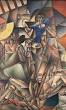
The Fascinating World of Cubism Art
Cubism is a revolutionary art movement that emerged in the early 20th century, challenging traditional notions of representation and perspective. Led by pioneering artists Pablo Picasso and Georges Braque, Cubism introduced a new way of seeing and interpreting the world.
At its core, Cubism seeks to depict objects from multiple viewpoints simultaneously, breaking them down into geometric shapes and abstract forms. This fragmented approach to representation creates a dynamic and multifaceted visual experience for the viewer.
One of the key characteristics of Cubist art is the emphasis on flat, two-dimensional surfaces rather than realistic depth. Artists often used techniques such as overlapping planes, multiple perspectives, and distorted forms to convey a sense of movement and energy within their compositions.
Through its innovative approach to form and structure, Cubism challenged conventional artistic conventions and paved the way for future movements such as Surrealism and Abstract Expressionism. Its influence can be seen across various art forms, from painting and sculpture to architecture and design.
Some of the most iconic works of Cubism include Picasso’s “Les Demoiselles d’Avignon” and Braque’s “Violin and Candlestick,” which exemplify the movement’s bold experimentation with shape, colour, and space.
Today, Cubism continues to captivate audiences with its unique visual language and avant-garde spirit. Its legacy lives on in the work of contemporary artists who draw inspiration from its revolutionary principles to create new forms of artistic expression.
As we reflect on the enduring impact of Cubism on the art world, we are reminded of its power to challenge perceptions, ignite creativity, and push boundaries. It remains a testament to the boundless possibilities of artistic innovation and imagination.
Exploring Cubism: 9 Essential Tips to Understand the Revolutionary Art Movement
- Cubism was an art movement that revolutionised European painting and sculpture.
- It was developed by Pablo Picasso and Georges Braque in the early 20th century.
- Cubist artists depicted subjects from multiple viewpoints to represent them in a greater context.
- The style is characterised by geometric shapes, interlocking planes, and fragmented forms.
- Colour palette in Cubism is often muted, with earth tones dominating the artworks.
- Cubist artworks often challenge traditional perspectives and invite viewers to interpret the subject differently.
- Collage techniques were frequently used in Cubist art to create dynamic compositions.
- ‘Les Demoiselles d’Avignon’ by Picasso is considered a seminal work of early Cubism.
- ‘Three Musicians’ is another famous Cubist painting by Picasso that showcases the style’s innovation.
Cubism was an art movement that revolutionised European painting and sculpture.
Cubism, an art movement that revolutionised European painting and sculpture, emerged as a groundbreaking force in the early 20th century. Led by visionaries such as Pablo Picasso and Georges Braque, Cubism shattered traditional artistic conventions by introducing a radical new approach to representation and perspective. By deconstructing forms into geometric shapes and abstract structures, Cubist artists challenged viewers to see the world in a fresh, dynamic light, marking a pivotal moment in the evolution of modern art.
It was developed by Pablo Picasso and Georges Braque in the early 20th century.
Cubism art, a groundbreaking movement developed by Pablo Picasso and Georges Braque in the early 20th century, revolutionised the way artists approached representation and perspective. By breaking down objects into geometric shapes and presenting multiple viewpoints simultaneously, Cubism challenged traditional artistic conventions and introduced a new visual language that continues to inspire and captivate audiences to this day.
Cubist artists depicted subjects from multiple viewpoints to represent them in a greater context.
In the realm of Cubism art, artists employed a groundbreaking technique of portraying subjects from multiple viewpoints, allowing them to capture a more comprehensive and nuanced representation within their works. By presenting objects from various angles simultaneously, Cubist artists sought to provide viewers with a deeper understanding of the subject matter, inviting them to explore different facets and perspectives within a single composition. This innovative approach not only challenged traditional modes of representation but also encouraged audiences to engage with art in a more dynamic and interactive way, fostering a rich tapestry of visual storytelling and interpretation.
The style is characterised by geometric shapes, interlocking planes, and fragmented forms.
Cubism art is distinguished by its distinctive features of geometric shapes, interlocking planes, and fragmented forms. This avant-garde style challenges traditional notions of representation by breaking down objects into abstract elements and presenting them from multiple viewpoints simultaneously. The use of geometric shapes and interlocking planes creates a sense of dynamism and movement within the composition, while the fragmented forms invite viewers to engage with the artwork in a more complex and multidimensional way. Cubism’s innovative approach to structure and form continues to captivate audiences with its bold experimentation and revolutionary spirit.
Colour palette in Cubism is often muted, with earth tones dominating the artworks.
In Cubism art, the colour palette is frequently subdued, with earth tones taking precedence in the artworks. This deliberate choice of muted colours adds a sense of harmony and unity to the fragmented forms and geometric shapes characteristic of Cubist compositions. By using earthy hues such as browns, greens, and ochres, artists in the Cubist movement were able to evoke a sense of depth and texture while maintaining a cohesive visual language that enhances the overall impact of their work.
Cubist artworks often challenge traditional perspectives and invite viewers to interpret the subject differently.
Cubist artworks present a captivating challenge to traditional perspectives, encouraging viewers to engage with the subject matter in a fresh and innovative way. By deconstructing and reassembling forms through geometric shapes and abstract compositions, Cubist artists invite us to see beyond the surface and explore multiple viewpoints simultaneously. This dynamic approach not only sparks curiosity but also prompts a deeper interpretation of the subject, inviting us to embrace the complexity and richness of visual expression in a whole new light.
Collage techniques were frequently used in Cubist art to create dynamic compositions.
Collage techniques were a prevalent feature in Cubist art, serving as a means to construct dynamic compositions that challenged traditional notions of representation. By incorporating elements such as newspaper clippings, fabric swatches, and other found objects into their artwork, Cubist artists were able to introduce new textures and layers that added depth and complexity to their pieces. This innovative approach to collage not only enhanced the visual impact of the artworks but also contributed to the movement’s overall exploration of fragmented perspectives and multiple viewpoints.
‘Les Demoiselles d’Avignon’ by Picasso is considered a seminal work of early Cubism.
“Les Demoiselles d’Avignon” by Picasso is widely regarded as a seminal work of early Cubism. This groundbreaking painting, created in 1907, marked a significant departure from traditional artistic conventions and heralded a new era of artistic experimentation. Through its bold use of geometric shapes, fragmented forms, and multiple perspectives, Picasso challenged the notion of representation and redefined the possibilities of visual expression. “Les Demoiselles d’Avignon” remains a testament to Picasso’s innovative vision and enduring influence on the development of modern art.
‘Three Musicians’ is another famous Cubist painting by Picasso that showcases the style’s innovation.
“Three Musicians” by Picasso stands as another renowned masterpiece of Cubist art, exemplifying the movement’s innovative approach to representation. In this iconic painting, Picasso skillfully deconstructs the figures of three musicians into geometric shapes and abstract forms, creating a dynamic composition that challenges traditional notions of perspective and form. Through his bold use of colour, shape, and composition, Picasso invites viewers into a vibrant and complex world where the boundaries between reality and abstraction blur. “Three Musicians” serves as a testament to Picasso’s mastery of Cubism and his enduring influence on the evolution of modern art.