
Michelangelo’s Artwork: A Master of Sculpture, Painting and Architecture
Michelangelo Buonarroti (1475–1564) was one of the defining artists of the Italian Renaissance. Celebrated for his sculpture, painting and architecture, he brought a remarkable sense of energy and emotional depth to the human figure. His work reflects a close study of anatomy, a powerful imagination and an enduring interest in the relationship between physical beauty and spiritual meaning.
A sculptor’s vision
Michelangelo regarded sculpture as his foremost calling. He worked directly with marble, shaping figures that seem to emerge from the stone. His best-known sculptures demonstrate both technical precision and an intense understanding of human expression.
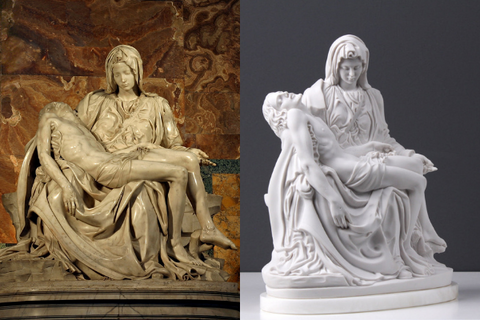
The Pietà, completed around 1499, depicts the Virgin Mary holding the body of Christ. Carved from marble, the work is admired for its calm composition, finely finished surfaces and poignant subject. Michelangelo was still in his early twenties when he made it.
His David, carved between 1501 and 1504, presents the biblical hero before his confrontation with Goliath. Rather than showing the moment of victory, Michelangelo portrays David alert and poised, with tension visible in his stance and expression. The colossal statue became a symbol of the city of Florence and remains one of the most recognised works of Renaissance art.
Other important sculptures include Moses, made for the tomb of Pope Julius II, and the unfinished Prisoners, also known as the Slaves. In the latter works, figures appear to struggle free from the marble, offering a striking glimpse of Michelangelo’s working process as well as his artistic imagination.
The Sistine Chapel
Michelangelo’s most ambitious painting project was the ceiling of the Sistine Chapel in the Vatican. Painted between 1508 and 1512, it brings together scenes from the Book of Genesis, prophets, sibyls and other figures within an intricate architectural design. The central panels include the famous Creation of Adam, in which God and Adam reach towards one another.
The ceiling is remarkable for its scale and for the variety of figures that fill it. Michelangelo’s command of anatomy gives the painted bodies a convincing sense of weight and movement, while the composition guides the eye across the chapel’s vast surface.
More than two decades later, Michelangelo returned to the chapel to paint The Last Judgment on the altar wall. Completed in 1541, it depicts the Second Coming of Christ and the final judgement of souls. Compared with the balanced order of the ceiling, the wall painting feels more turbulent, reflecting the drama and uncertainty of its subject.
Architecture and later work
Michelangelo also made a lasting contribution to architecture. Among his projects in Florence was the design of the Laurentian Library, known for its distinctive staircase and inventive use of space. In Rome, he was appointed chief architect of St Peter’s Basilica. He redesigned parts of the building and developed the plan for its great dome, although the dome was completed after his death.
His later years included devotional works such as the Rondanini Pietà, which remained unfinished at his death. Its elongated forms and rougher surfaces differ from the polished finish of his earlier sculpture, suggesting an artist still exploring new ways to express spiritual feeling.
A lasting influence
Michelangelo’s artwork shaped the development of Western art for generations. Artists studied his figures for their anatomy, movement and expressive force, while architects looked to his bold approach to form and space. His influence can be seen in the art that followed the Renaissance, particularly in the dramatic style known as Mannerism.
Today, Michelangelo’s works continue to draw visitors and inspire artists around the world. Whether encountered in marble, fresco or architecture, they reveal an extraordinary ability to combine technical mastery with human intensity.
Michelangelo’s Artwork: Frequently Asked Questions
- What is Michelangelo’s most famous artwork?
- Where can Michelangelo’s artwork be seen?
- What is the story behind Michelangelo’s David?
- How long did Michelangelo take to paint the Sistine Chapel ceiling?
- What techniques and materials did Michelangelo use in his artwork?
What is Michelangelo’s most famous artwork?
Michelangelo’s most famous artwork is often considered to be the ceiling of the Sistine Chapel in Vatican City, painted between 1508 and 1512. Its many biblical scenes include the iconic Creation of Adam, showing God and Adam reaching towards one another. His marble sculpture David is another strong contender for his best-known work.
Where can Michelangelo’s artwork be seen?
Michelangelo’s artwork can be seen in museums, churches and historic buildings across Italy. Highlights include the David at the Galleria dell’Accademia and the Pietà in St Peter’s Basilica, both in Rome, while his frescoes cover the ceiling and altar wall of the Sistine Chapel in the Vatican. Other notable works are housed at the Medici Chapels in Florence and the Louvre in Paris. Check opening times and booking requirements before visiting, as popular sites can be busy.
What is the story behind Michelangelo’s David?
Michelangelo’s David depicts the biblical hero just before his battle with Goliath, rather than celebrating his victory afterwards. Carved from a single block of marble between 1501 and 1504, the colossal figure captures David’s concentration and resolve through his tense posture, watchful gaze and the sling resting over his shoulder. The sculpture was commissioned for Florence Cathedral, but its impressive scale led to it being placed outside the Palazzo della Signoria, where it came to symbolise the city’s independence and civic strength. Today, the original is housed in Florence’s Galleria dell’Accademia.
How long did Michelangelo take to paint the Sistine Chapel ceiling?
Michelangelo took about four years to paint the Sistine Chapel ceiling, working on it from 1508 to 1512. The vast fresco project involved painting scenes from the Book of Genesis, along with prophets, sibyls and other figures. Although often imagined lying on his back, Michelangelo painted from scaffolding, with his head tilted upwards for long periods—a demanding task that required considerable physical effort.
What techniques and materials did Michelangelo use in his artwork?
Michelangelo worked in a range of media, choosing techniques to suit each project. As a sculptor, he carved marble with chisels and other hand tools, carefully revealing figures within the stone; he also modelled in clay and used bronze for some works. For painting, he was especially skilled in fresco, applying pigments to wet plaster to create the Sistine Chapel ceiling and The Last Judgment. His practice relied on close observation of anatomy, preparatory drawings and strong, sculptural forms, which gave his figures their distinctive sense of volume and movement.