
World-Famous Paintings: The Stories Behind Iconic Works of Art
Some paintings are so widely recognised that their images have travelled far beyond the galleries where they hang. They appear in books, films, classrooms and popular culture, yet the originals often have stories that are less familiar. From enigmatic portraits to bold experiments in colour, world-famous paintings continue to capture attention because they offer more than a striking image: they invite us to look, wonder and interpret.
The Mona Lisa by Leonardo da Vinci
Few paintings are as instantly recognisable as Leonardo da Vinci’s Mona Lisa. Painted in the early 16th century, the portrait is celebrated for its subtle modelling, carefully composed landscape and the subject’s famously elusive smile. Leonardo’s soft transitions between light and shadow, known as sfumato, give the face a lifelike quality.
The painting is displayed at the Louvre in Paris, where it draws visitors from around the world. Its fame owes much to its artistic innovation, but also to its long history and the fascination generated by the identity and expression of its subject.
The Starry Night by Vincent van Gogh
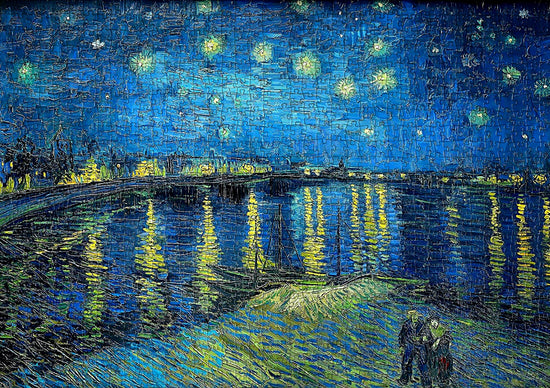
Vincent van Gogh painted The Starry Night in 1889 while living at the Saint-Paul-de-Mausole asylum in Saint-Rémy-de-Provence. The night sky sweeps across the canvas in vivid blues and swirling forms, while a quiet village sits beneath it. The contrast between the restless sky and the still settlement gives the work much of its emotional force.
Van Gogh’s expressive brushwork makes the scene feel less like a straightforward view and more like a personal response to the world around him. Today, the painting is one of the best-known works in the collection of New York’s Museum of Modern Art.
The Girl with a Pearl Earring by Johannes Vermeer
Johannes Vermeer’s Girl with a Pearl Earring is often described as a portrait, though it is more accurately understood as a tronie: a study of a character or expression rather than a formal likeness of a named person. The young woman turns towards the viewer, her lips slightly parted and a large pearl catching the light.
Vermeer’s restrained palette and sensitive handling of light give the image an intimate quality. The painting is held by the Mauritshuis in The Hague and remains compelling precisely because so much about its subject is unknown.
The Persistence of Memory by Salvador Dalí
In Salvador Dalí’s surrealist painting The Persistence of Memory, limp watches drape over a barren landscape and an oddly formed central figure. The image challenges the familiar idea that time is fixed and orderly, replacing it with a dreamlike scene that seems to follow its own logic.
Completed in 1931, the small painting has become one of the most recognisable images of Surrealism. Its precise technique makes the impossible objects appear strangely convincing, encouraging viewers to question what they are seeing.
Guernica by Pablo Picasso
Pablo Picasso created Guernica in response to the 1937 bombing of the Basque town of Guernica during the Spanish Civil War. In a monumental composition of fractured figures and stark black, white and grey, the painting conveys the suffering and chaos of war.
Rather than depicting the event as a realistic scene, Picasso used distortion and symbolism to communicate its human cost. Guernica has since become an enduring anti-war statement and is displayed at the Museo Reina Sofía in Madrid.
Why do certain paintings become famous?
Artistic quality is only part of the story. A painting may become famous because it captures a defining moment, introduces a radical style or speaks to concerns that remain relevant across generations. Its reputation can also grow through its history, the artists and collectors connected with it, and the institutions that preserve and exhibit it.
Reproductions have helped these works reach audiences far beyond museum walls, but seeing a painting in person can reveal details that images cannot fully convey: the scale of the canvas, the texture of the paint and the way colours change with the light.
A continuing conversation
World-famous paintings are not simply relics of the past. Each generation brings new questions to them, finding fresh meanings in familiar images. Whether admired for technical skill, emotional power or sheer mystery, these works remind us that a painting can continue to speak long after it was created.
Celebrating the Timeless Impact of World-Famous Paintings: Skill, Storytelling, Inspiration, Culture, and Unity
- Showcase remarkable artistic skill.
- Tell stories across generations.
- Inspire creativity and new ideas.
- Reflect the cultures of their time.
- Bring people together through art.
The Challenges of Appreciating World-Famous Paintings: Crowds, Commercialisation, Reproductions, and Security Costs
- Crowded galleries can make viewing difficult.
- Famous works may be over-commercialised.
- Reproductions can overshadow lesser-known artists.
- High-value paintings require costly security.
Showcase remarkable artistic skill.
World-famous paintings showcase remarkable artistic skill, from the confident handling of paint and colour to the careful composition and fine attention to detail. Looking closely at works by celebrated artists reveals the patience, knowledge and creativity behind each brushstroke. These paintings demonstrate how technical mastery can bring figures, landscapes and ideas to life, while leaving a lasting impression on viewers across generations.
Tell stories across generations.
World-famous paintings tell stories that travel across generations. Through their subjects, symbols and historical settings, they offer a window into the beliefs, experiences and emotions of people from another time. Each generation can discover something different in the same work, keeping its story alive and creating a shared connection between the past and the present.
Inspire creativity and new ideas.
World-famous paintings can inspire creativity by showing how artists have transformed observations, emotions and ideas into powerful visual works. Their inventive use of colour, composition and technique encourages viewers to look at the world differently and experiment with their own ways of expressing themselves. A familiar masterpiece can spark fresh ideas, whether for painting, writing, design or simply seeing everyday life from a new perspective.
Reflect the cultures of their time.
World-famous paintings offer a glimpse into the cultures and values of the periods in which they were created. Through their subjects, clothing, settings and artistic styles, they can reveal what people admired, feared or considered important. Looking closely at these details helps us understand how societies changed over time, while reminding us that every work of art reflects the perspective and circumstances of its age.
Bring people together through art.
World-famous paintings bring people together through a shared experience of art. Visitors from different backgrounds can stand before the same work, exchange impressions and discover new perspectives in one another’s interpretations. Whether encountered in a gallery, a book or online, these paintings can spark conversations across generations and cultures, reminding us that images and emotions can connect people even when they do not share the same language.
Crowded galleries can make viewing difficult.
Crowded galleries can make it difficult to enjoy world-famous paintings at your own pace. Visitors may have to wait for a clear view, jostle for space or look at the artwork from a distance, making it harder to notice fine details and appreciate its scale. The noise and bustle can also detract from the quiet, contemplative experience many people hope to have in front of a great work of art.
Famous works may be over-commercialised.
Famous paintings can become so heavily commercialised that their artistic meaning risks being overshadowed by their image on souvenirs, clothing and advertising. When a work is reproduced endlessly, it may start to feel familiar or even generic, rather than something to be experienced and considered. This can also reduce complex artworks to recognisable symbols, separating them from the history, ideas and craftsmanship that made them significant in the first place.
Reproductions can overshadow lesser-known artists.
The popularity of world-famous paintings can leave less familiar artists in their shadow. Reproductions of iconic works are easy to find in books, online and on merchandise, making them more visible than artists whose work receives less attention. As a result, audiences may repeatedly encounter the same celebrated images while overlooking the variety of styles, ideas and perspectives found elsewhere. Making space for emerging and lesser-known artists helps broaden our understanding of art beyond the familiar masterpieces.
High-value paintings require costly security.
High-value paintings require costly security to protect them from theft, vandalism and accidental damage. Galleries and collectors may need specialist alarms, reinforced display cases, trained security staff and carefully controlled environmental conditions, all of which can be expensive to install and maintain. These measures are essential for safeguarding irreplaceable works, but the ongoing costs can place a significant burden on museums and owners.