
Abstract Artworks: Looking Beyond the Familiar
Abstract art invites us to experience art without relying on recognisable subjects. Rather than depicting a person, place or object in a realistic way, an abstract artwork may use colour, shape, line, texture and form to create its own visual language. The result can feel bold and immediate, quiet and contemplative, or somewhere in between.
What makes an artwork abstract?
Abstract artworks range from pieces that simplify familiar subjects to compositions with no obvious reference to the visible world. Some retain hints of landscapes, figures or everyday objects; others focus entirely on relationships between colours, marks and shapes.
There is no single style of abstraction. Geometric works may feature carefully arranged forms and clean lines, while gestural paintings can reveal the movement and energy of the artist’s hand. Other abstract artworks explore subtle shifts in tone, layered surfaces or the texture of their materials.
A brief history of abstraction
Artists began exploring abstraction in new ways during the late 19th and early 20th centuries. Developments in modern life, changes in artistic materials and fresh ideas about perception encouraged painters and sculptors to move beyond traditional representation. Instead of aiming to reproduce what they saw, artists increasingly explored how colour, form and composition could communicate independently.
Over time, abstract art developed into many movements and individual approaches. Some artists pursued simplicity and order; others embraced spontaneity, emotion and experimentation. Today, abstraction continues to evolve across painting, sculpture, printmaking, photography and digital media.
How to look at an abstract artwork
Abstract art does not always offer a clear story or a single interpretation. That openness is part of its appeal. When spending time with an artwork, notice what draws your attention first. Is it a particular colour, a repeated shape or the direction of a brushstroke? Consider how the composition guides your eye and whether the work feels balanced, unsettled, calm or energetic.
It can also be useful to look at the surface. Thick paint, visible marks, overlapping layers or smooth, even areas all affect the way an artwork feels. You might ask what associations the work brings to mind, while remembering that your response does not need to match anyone else’s. The artist’s title or choice of materials may offer clues, but the viewer’s own experience matters too.
Why abstract art still matters
Abstract artworks can make room for feelings and ideas that are difficult to express through literal imagery. They encourage close looking and leave space for curiosity. A work may change in character as it is viewed from different distances or encountered in different surroundings.
Whether you are discovering abstraction for the first time or returning to a much-loved piece, there is no need to find a definitive meaning. Take time to notice the details, follow your reactions and let the artwork reveal itself gradually. Abstract art rewards attention—and often leaves space for a new interpretation each time you look.
Abstract Art FAQs: Famous Paintings, Examples, Types and 2026 Trends
- What is the most famous piece of abstract art?
- What are the 10 most famous abstract paintings?
- What are examples of abstract art?
- What is an example of abstract art?
- What are the four types of abstract art?
- What are the trends in abstract art for 2026?
- What are the 3 types of abstract art?
- What is abstract art art?
What is the most famous piece of abstract art?
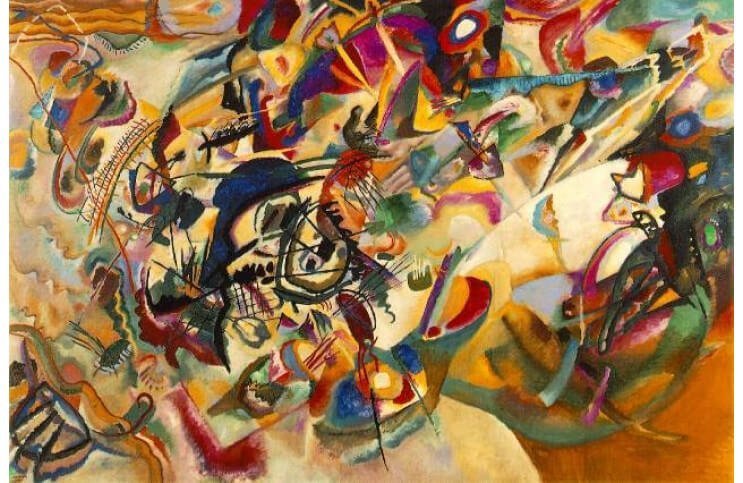
There is no universally agreed “most famous” abstract artwork, but Wassily Kandinsky’s Composition VII (1913) is often regarded as one of the best-known and most influential early examples. Other familiar works include Piet Mondrian’s geometric compositions and Jackson Pollock’s energetic drip paintings. Which piece feels most famous often depends on the viewer’s tastes and what they have encountered in galleries, books and popular culture.
What are the 10 most famous abstract paintings?
There is no definitive ranking, but ten of the most widely recognised abstract paintings include Wassily Kandinsky’s Composition VII and Several Circles, Kazimir Malevich’s Black Square, Piet Mondrian’s Broadway Boogie Woogie, Jackson Pollock’s Convergence and No. 5, 1948, Mark Rothko’s Orange, Red, Yellow, Barnett Newman’s Vir Heroicus Sublimis, Willem de Kooning’s Woman I and Hilma af Klint’s The Ten Largest. These works represent a range of approaches to abstraction, from geometric compositions and bold fields of colour to energetic, gestural brushwork.
What are examples of abstract art?
Examples of abstract art include Piet Mondrian’s geometric compositions of grids and primary colours, Wassily Kandinsky’s expressive arrangements of shapes and lines, and Jackson Pollock’s energetic, layered drip paintings. Abstract artworks can also include sculptures, collages and contemporary digital pieces. Some suggest recognisable subjects, such as landscapes or figures, while others focus on colour, texture, pattern and form without depicting anything specific.
What is an example of abstract art?
A well-known example of abstract art is Wassily Kandinsky’s Composition VIII (1923). The painting brings together geometric shapes, circles and intersecting lines in a carefully balanced composition, without depicting a recognisable scene. Its colours and forms invite viewers to respond to the work’s rhythm, movement and mood in their own way.
What are the four types of abstract art?
There is no universally agreed list of four types of abstract art, but artworks are often grouped into broad approaches: geometric abstraction, which uses precise shapes and structured compositions; gestural abstraction, which emphasises expressive brushstrokes and movement; lyrical abstraction, which tends to feel more fluid and intuitive; and colour field painting, which uses expanses of colour to create atmosphere and emotion. These categories can overlap, and many artists combine elements of more than one approach.
What are the trends in abstract art for 2026?
Trends to watch in abstract art for 2026 include richly textured surfaces, layered mixed-media compositions and work that combines digital techniques with traditional painting. Earthy colours, organic shapes and nature-inspired marks remain relevant, alongside bold colour contrasts and geometric experimentation. Sustainability is another area of interest, with artists exploring reclaimed materials and lower-impact processes. Generative tools are also prompting experimentation and debate around authorship and originality. These are broad directions rather than fixed rules: abstract art remains diverse, and an artwork’s individual character matters more than whether it follows a trend.
What are the 3 types of abstract art?
There is no universally agreed list of three types of abstract art, but a useful way to group it is into geometric abstraction, gestural abstraction and colour-field painting. Geometric abstraction uses clear shapes, lines and structured compositions; gestural abstraction emphasises expressive brushstrokes, movement and spontaneity; and colour-field painting uses broad areas of colour to create mood and atmosphere. Many artworks combine elements of more than one approach.
What is abstract art art?
Abstract art is artwork that does not aim to represent people, places or objects exactly as they appear in real life. Instead, it uses elements such as colour, shape, line, texture and form to express ideas, emotions or movement. Some abstract art hints at recognisable subjects, while other works are entirely non-representational, leaving viewers free to form their own interpretations.