
Jackson Pollock: The Artist Who Changed Modern Painting
Jackson Pollock was an American artist whose bold, experimental paintings helped reshape modern art. A leading figure in Abstract Expressionism, he became famous for works made by pouring, dripping and splashing paint across large canvases. His approach challenged traditional ideas about how a painting should be made—and what it could mean.
Who was Jackson Pollock?
Paul Jackson Pollock was born in Cody, Wyoming, in 1912. He studied art in New York, where he encountered a range of influences, including Mexican mural painting and Native American art. During the 1940s, he developed the distinctive method that would make him one of the most recognisable artists of the twentieth century.
Pollock lived and worked in Springs, Long Island, with the painter Lee Krasner, whom he married in 1945. He died in a car accident in 1956, aged 44. Though his career was relatively short, his work had a lasting impact on artists and audiences around the world.
The drip paintings
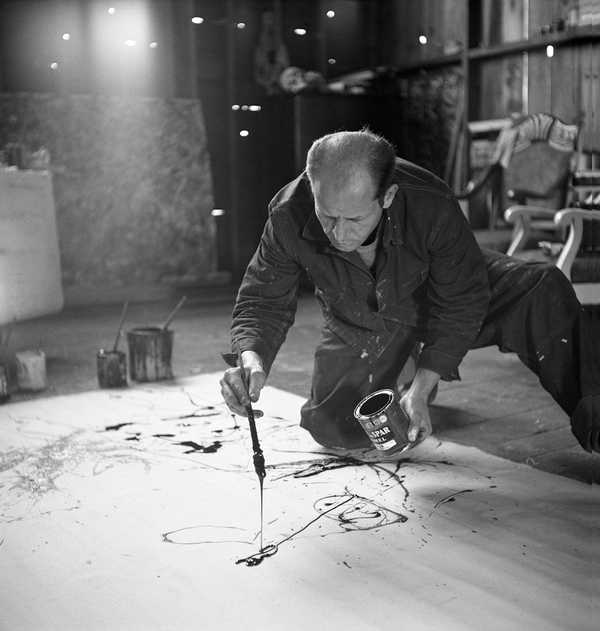
Pollock’s best-known paintings were created with the canvas laid flat on the floor. Rather than applying paint with a brush in the conventional way, he moved around the canvas, letting paint fall from sticks, brushes and cans. He used household and industrial paints as well as artists’ materials, building up intricate webs of line, colour and texture.
This technique is often called “drip painting” or “action painting”. The terms describe both the materials and the physical process involved. Pollock’s movements became part of the work, but the paintings were not simply random splashes. He adjusted the flow, density and placement of the paint, layering marks until the composition felt complete.
What makes his art distinctive?
Many of Pollock’s canvases have no obvious central subject. Instead, lines and forms spread across the surface, encouraging the eye to move in different directions. This all-over approach makes the edges of the canvas feel as important as its centre. Viewers may discover shifting patterns, colour contrasts and moments of detail rather than a single fixed image.
His paintings can be energetic and intense, yet they also reward close attention. From a distance, a canvas may appear to form a unified field; up close, it reveals overlapping strokes, drips and delicate changes in colour. Each viewing can bring out a different rhythm or relationship between the marks.
Notable works
Among Pollock’s celebrated works are Autumn Rhythm (Number 30) (1950), a vast canvas of interwoven black, white and earthy lines, and Blue Poles (1952), which combines dense layers of paint with striking blue vertical forms. His 1948 painting often known as Number 1A is another important example of his developed drip technique.
Pollock’s influence
Pollock helped establish New York as a major centre of the post-war art world and became an emblem of Abstract Expressionism. His work encouraged artists to think differently about gesture, materials and the act of painting itself. It also prompted debate: some viewers saw the paintings as radical and expressive, while others questioned whether they were art at all.
That debate remains part of his legacy. Pollock’s paintings do not offer a single story or interpretation. Instead, they invite viewers to look closely, follow the movement of the paint and decide what the experience means to them. His influence endures because he expanded the possibilities of painting—and made the process itself impossible to ignore.
Jackson Pollock: Frequently Asked Questions About His Life, Art and Drip Painting Technique
- Who was Jackson Pollock?
- What is Jackson Pollock famous for?
- What is Jackson Pollock’s drip painting technique?
- What are Jackson Pollock’s most famous paintings?
- Where can I see Jackson Pollock’s paintings?
Who was Jackson Pollock?
Jackson Pollock (1912–1956) was an American painter and a leading figure in Abstract Expressionism, a movement that became influential after the Second World War. He is best known for his large, energetic paintings made by dripping, pouring and splashing paint onto canvases laid flat on the floor. Pollock’s innovative approach made the act of painting part of the artwork and had a lasting impact on modern art.
What is Jackson Pollock famous for?
Jackson Pollock is famous for his distinctive drip paintings, created by pouring, splashing and flicking paint onto large canvases laid flat on the floor. A leading figure in Abstract Expressionism, he transformed the act of painting into a dynamic, physical process, producing intricate compositions of layered lines, colours and textures. His innovative technique challenged traditional ideas about art and made him one of the most influential artists of the 20th century.
What is Jackson Pollock’s drip painting technique?
Jackson Pollock’s drip painting technique involved laying a large canvas flat on the floor and applying paint by dripping, pouring or flicking it from brushes, sticks and cans. Moving around the canvas, he built up layers of lines, splashes and patterns using controlled gestures rather than traditional brushstrokes. The method made the act of painting part of the artwork, creating energetic, all-over compositions with no single focal point.
What are Jackson Pollock’s most famous paintings?
Jackson Pollock’s most famous paintings include Number 1A, 1948, Autumn Rhythm (Number 30) (1950), Lavender Mist: Number 1 (1950), Convergence (1952) and Blue Poles: Number 11, 1952. These large-scale works showcase his distinctive drip-painting technique, with layers of poured and splattered paint creating energetic, intricate patterns across the canvas.
Where can I see Jackson Pollock’s paintings?
Jackson Pollock’s paintings can be seen in major museums around the world, including Tate Modern in London, which holds Summertime: Number 9A, and the Museum of Modern Art in New York, home to One: Number 31, 1950. Other works are held by the National Gallery of Art in Washington, DC, and the Peggy Guggenheim Collection in Venice. Display schedules can change, so check each museum’s website before visiting; many collections also provide details and images online.