
Diego Velázquez Paintings: A Guide to the Spanish Master
Diego Velázquez (1599–1660) is widely regarded as one of the greatest painters of the Spanish Golden Age. Best known for his portraits of the Spanish royal family, he also painted religious scenes, mythological subjects and everyday life. His work is admired for its lifelike presence, subtle use of light and remarkable ability to suggest character with a few carefully chosen brushstrokes.
Velázquez spent much of his career at the court of King Philip IV, where he became the king’s trusted portraitist. Yet his paintings are more than formal records of court life. They show a close observation of people, from monarchs and courtiers to servants, soldiers and ordinary citizens.
From Seville to the royal court
Born in Seville, Velázquez trained under the painter Francisco Pacheco, whose daughter Juana he later married. His early works include Old Woman Frying Eggs (1618), a scene of everyday life painted with close attention to the textures of food, pottery and fabric. These early paintings, sometimes known as bodegones, show his interest in ordinary subjects and his skill in making them feel immediate and substantial.
In 1623, Velázquez travelled to Madrid and painted a portrait of Philip IV. The king was impressed, and Velázquez was appointed court painter. His position gave him access to the royal household and opportunities to study works by other artists, including during visits to Italy. Over time, his style became freer and more economical, with loose marks that combine into convincing forms when viewed from a distance.
Famous paintings by Diego Velázquez
Las Meninas (1656)
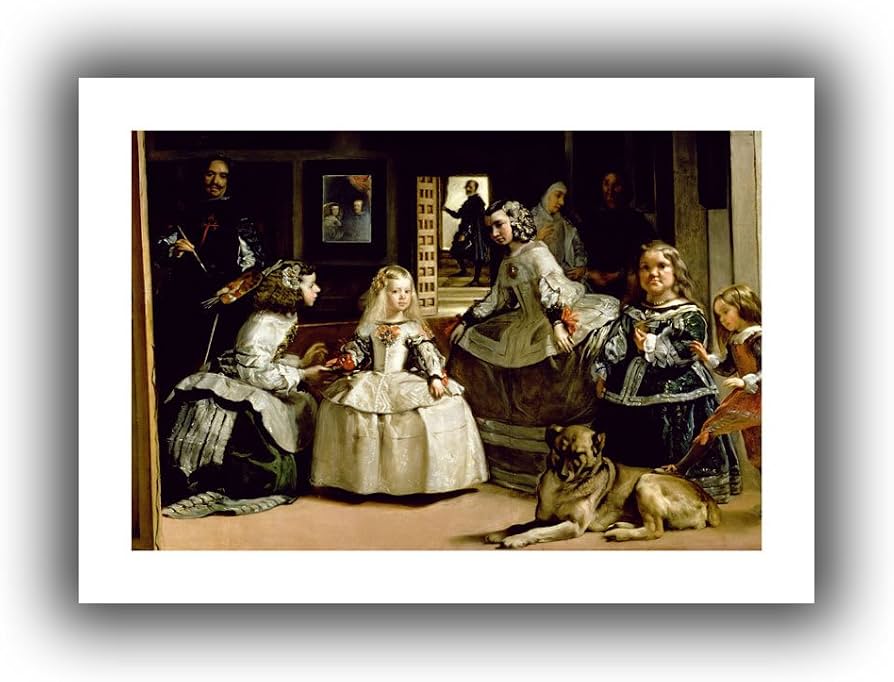
Las Meninas is Velázquez’s most celebrated painting and one of the most discussed works in European art. It depicts the young Infanta Margarita surrounded by her attendants, or meninas, in a room at the royal palace. Velázquez appears at his easel, while a mirror at the back of the room reflects the figures of the king and queen.
The arrangement makes the viewer consider who is looking at whom. Are we standing where the monarchs would have stood, or are we being observed by the artist and his subjects? Velázquez leaves the scene open to interpretation, turning a court portrait into a complex exploration of painting, perspective and presence.
The Surrender of Breda (1634–35)
Also known as Las Lanzas (“The Lances”), this large historical painting portrays the 1625 surrender of the Dutch city of Breda to Spanish forces. Rather than focusing on violence, Velázquez presents the moment after the siege, as the Dutch commander hands over the city’s key to the Spanish general, Ambrogio Spinola. The respectful gesture between the two men gives the painting an unusually humane tone for a scene of military victory.
Portrait of Pope Innocent X (c. 1650)
Painted during Velázquez’s second visit to Italy, this portrait is renowned for its vivid characterisation. The pope sits in red robes, looking directly at the viewer. Velázquez captures both his authority and his guarded, searching expression through precise observation rather than idealisation. The painting later inspired Francis Bacon’s series of reworked portraits, demonstrating its lasting influence.
The Rokeby Venus (c. 1647–51)
Velázquez’s Rokeby Venus, also called The Toilet of Venus, is his only surviving female nude. Venus is shown from behind, gazing into a mirror held by Cupid. The soft treatment of the figure and the blurred reflection give the work a quiet, intimate quality. The painting is now held by the National Gallery in London.
A distinctive approach to painting
Velázquez’s paintings combine careful observation with an apparent ease of execution. He could render the sheen of silk, the softness of skin or the weight of armour, but he rarely relied on excessive detail. Instead, he used colour, light and expressive brushwork to create the impression of reality. His figures feel present because they are painted as individuals, not simply as symbols of rank or status.
His influence reached far beyond Spain. Later artists, including Francisco Goya, Édouard Manet and Pablo Picasso, studied and admired his work. Today, Velázquez’s paintings continue to attract viewers for their technical brilliance and psychological depth. Whether depicting a king, a pope, a court attendant or a scene from everyday life, he invites us to look closely—and to wonder what lies beyond the image.
Exploring the Mastery of Diego Velázquez: Frequently Asked Questions About His Renowned Paintings
- Why is Velázquez so highly regarded?
- What is Diego Velázquez’s most famous painting?
- What is Diego Velázquez famous for?
- What is Diego Velázquez known for?
- Where are Diego Velazquez paintings now?
- What was Diego Velazquez most known piece of artwork?
Why is Velázquez so highly regarded?
Velázquez is so highly regarded for his exceptional skill in capturing the presence and character of his subjects. With remarkably subtle use of light, colour and brushwork, he made portraits feel lifelike without relying on elaborate detail. His paintings also show unusual psychological depth, inviting viewers to consider the people behind their titles and roles. Works such as Las Meninas demonstrate his technical mastery and inventive approach to perspective, while his influence on later artists—from Goya to Picasso—attests to his lasting importance in the history of painting.
What is Diego Velázquez’s most famous painting?
Diego Velázquez’s most famous painting is generally considered to be Las Meninas (1656), displayed at the Museo del Prado in Madrid. It shows the young Infanta Margarita with her attendants, while Velázquez appears at his easel and the king and queen are reflected in a mirror behind them. Its intriguing arrangement of figures and shifting viewpoints has made it one of the most studied and admired paintings in Western art.
What is Diego Velázquez famous for?
Diego Velázquez is famous for his masterful portraits, particularly those of the Spanish royal family and King Philip IV, whom he served as court painter. His best-known work, Las Meninas, is admired for its complex composition and playful exploration of perspective and the act of looking. Velázquez is also celebrated for his naturalistic style, subtle use of light and ability to capture the character and presence of his subjects.
What is Diego Velázquez known for?
Diego Velázquez is best known as a leading painter of Spain’s Golden Age and the court portraitist of King Philip IV. His paintings are celebrated for their lifelike detail, subtle use of light and sensitive portrayal of character. Among his most famous works are Las Meninas, the royal portrait Portrait of Pope Innocent X and the historical scene The Surrender of Breda.
Where are Diego Velazquez paintings now?
Diego Velázquez’s paintings are now held in museums and collections around the world, with the largest and most important group at the Museo del Prado in Madrid, including Las Meninas and The Surrender of Breda. Other works can be seen at institutions such as the National Gallery in London, which houses The Rokeby Venus, and the Metropolitan Museum of Art in New York. A number of his paintings are also in other European and international museums, so the best place to see a particular work depends on its location.
What was Diego Velazquez most known piece of artwork?
Diego Velázquez’s most famous painting is Las Meninas (1656), a complex portrait of the young Infanta Margarita and her attendants at the Spanish royal court. Velázquez includes himself at his easel, while a mirror in the background reflects the king and queen, inviting viewers to question who is observing whom. Celebrated for its masterful use of perspective, light and composition, Las Meninas is widely regarded as one of the most important paintings in Western art.