
Oskar Schlemmer’s Paintings: The Human Figure in a Geometric World
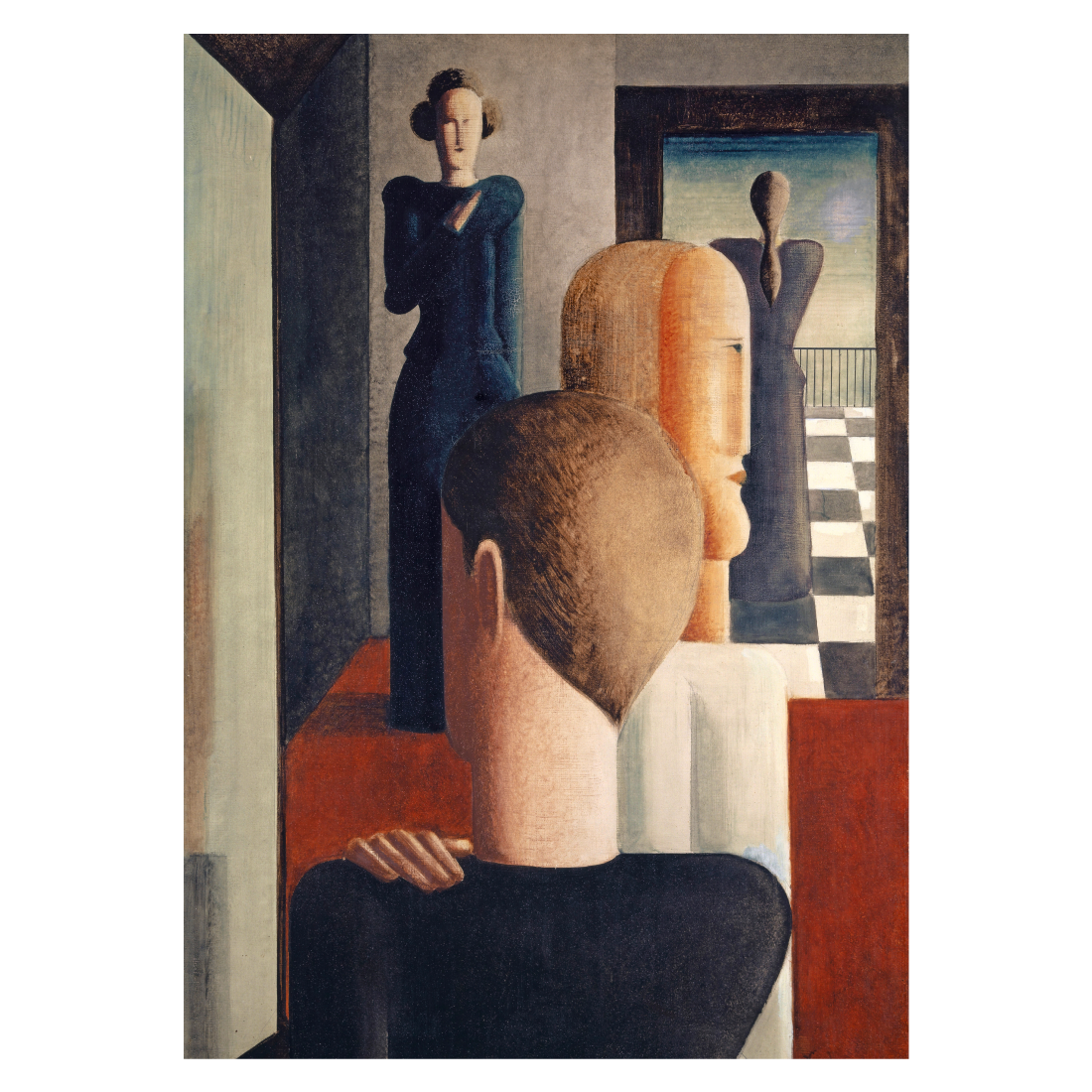
Oskar Schlemmer’s paintings place the human figure at the centre of a world shaped by geometry, rhythm and modern design. Best known for his work at the Bauhaus and for his experimental stage production The Triadic Ballet, Schlemmer brought together painting, sculpture, architecture and performance. His art asks how people inhabit space—and how the body might be understood as both a living presence and a carefully composed form.
Who was Oskar Schlemmer?
Oskar Schlemmer was born in Stuttgart in 1888. A painter, sculptor and theatre artist, he became closely associated with the Bauhaus, the influential German school of art, design and architecture. He joined its teaching staff in 1920 and went on to lead its stage workshop, exploring how movement, costume, colour and space could work together.
Schlemmer’s career unfolded during a period of rapid change in European art. Like many artists of his generation, he was interested in moving beyond naturalistic representation. Yet his work remained focused on people. Rather than simply depicting the figure as it appeared, he explored how bodies could be arranged, simplified and transformed within a structured environment.
Figures shaped by geometry
In many of Schlemmer’s paintings, figures have a poised, almost architectural quality. Their bodies may be simplified into clear volumes, while their gestures and positions create patterns across the composition. Circles, lines, planes and blocks of colour help define the space around them.
This approach can make the figures seem distant or enigmatic. They are recognisably human, but they can also resemble mannequins, performers or elements in a carefully designed stage set. The tension between individuality and abstraction is central to Schlemmer’s art: the body is at once expressive and ordered.
His paintings are not merely exercises in geometry. Their balance, spacing and muted or carefully controlled colours give them a quiet, contemplative mood. The figures often seem absorbed in their surroundings, prompting viewers to consider how posture and position communicate meaning.
Bauhaus Stairway
One of Schlemmer’s best-known paintings is Bauhaus Stairway (1932). It shows figures moving through a modern architectural interior, their forms arranged in relation to the building’s strong lines. The staircase becomes more than a backdrop: it helps organise the composition and directs the viewer’s eye through the scene.
The painting captures key concerns of Schlemmer’s work—the relationship between people and architecture, the use of movement within a designed space, and the transformation of everyday figures into a rhythmic arrangement. Its subject also reflects the Bauhaus ideal of bringing art and design into dialogue.
Painting, performance and The Triadic Ballet
Schlemmer’s paintings are closely connected to his work for the stage. In The Triadic Ballet, first performed in 1922, performers wore distinctive costumes that altered the apparent shape and movement of their bodies. The production developed ideas that also appear in his visual art: the body as form, movement as composition, and the stage as a space governed by proportion and design.
The ballet is not a painting, but it helps explain Schlemmer’s approach to the human figure. His interest extended beyond what a body looked like in a still image. He considered how it moved, how it occupied space and how costume or setting could change the way it was perceived.
Why Schlemmer’s paintings still matter
Schlemmer’s work continues to resonate because it brings together concerns that remain familiar in contemporary art and design. His paintings invite questions about the relationship between people and the built environment, the expressive potential of simplified forms, and the boundaries between fine art and performance.
Rather than treating the human body as a subject to be copied, Schlemmer used it as a way to investigate space, order and movement. His paintings are distinctive for their measured compositions and their unusual blend of human presence and geometric abstraction. They offer a thoughtful, lasting vision of modern life—one in which people and architecture are part of the same carefully balanced world.
Exploring Oskar Schlemmer: Frequently Asked Questions About His Iconic Paintings
- Who was Oskar Schlemmer?
- What are Oskar Schlemmer’s paintings known for?
- What is Oskar Schlemmer’s most famous painting?
- What is the meaning of Bauhaus Stairway?
- How did the Bauhaus influence Schlemmer’s paintings?
- Why did Schlemmer depict people as geometric or mannequin-like figures?
- How are Schlemmer’s paintings connected to The Triadic Ballet?
- Where can you see Oskar Schlemmer’s paintings?
Who was Oskar Schlemmer?
Oskar Schlemmer (1888–1943) was a German artist, choreographer and teacher, best known for his association with the Bauhaus, the influential school of art and design. He worked across painting, sculpture and theatre, exploring how the human figure could be shaped by geometry, movement and architecture. Schlemmer also led the Bauhaus stage workshop and created The Triadic Ballet, a landmark performance in which costumes transformed the dancers’ bodies into striking geometric forms.
What are Oskar Schlemmer’s paintings known for?
Oskar Schlemmer’s paintings are known for their stylised human figures, geometric forms and carefully balanced compositions. Often associated with the Bauhaus, his work explores how the body moves through and relates to space, architecture and design. Figures may appear simplified or almost mannequin-like, yet the measured arrangements of shape, colour and posture give them a distinctive sense of rhythm and quiet expression.
What is Oskar Schlemmer’s most famous painting?
Oskar Schlemmer’s best-known painting is often considered to be Bauhaus Stairway (1932). It depicts a group of stylised figures moving through the school’s modern interior, their forms arranged in harmony with the staircase and its clean architectural lines. The painting brings together key themes in Schlemmer’s work: the human body, geometric order and the relationship between people and the spaces they inhabit.
What is the meaning of Bauhaus Stairway?
Bauhaus Stairway (1932) shows a group of figures moving up a staircase, their simplified forms arranged in rhythm with the building’s clean lines. The painting is often read as a portrait of life at the Bauhaus, where people, architecture and design were closely connected. The upward movement may suggest learning, collective progress and faith in modern ideas, although Schlemmer leaves the scene open to interpretation. Painted as the Bauhaus faced closure in Dessau, it can also feel like a thoughtful tribute to the school and its community.
How did the Bauhaus influence Schlemmer’s paintings?
The Bauhaus’s emphasis on bringing art, design and architecture together had a strong influence on Oskar Schlemmer’s paintings. Its focus on geometry, balance and clear structure can be seen in his carefully arranged compositions, where simplified human figures interact with architectural space. Schlemmer also explored how bodies move through and occupy their surroundings, echoing the Bauhaus interest in designing environments for modern life. Rather than simply copying reality, he used geometric forms and controlled arrangements to express the relationship between people, space and movement.
Why did Schlemmer depict people as geometric or mannequin-like figures?
Schlemmer depicted people as geometric or mannequin-like figures to explore how the human body relates to space, architecture and movement. By simplifying the body into clear shapes, he moved away from naturalistic portraiture and highlighted its structure, posture and rhythm. The figures can seem like performers or parts of a stage design, reflecting his interest in theatre and the Bauhaus ideal of uniting art, design and architecture. Their carefully composed appearance also suggests a balance between individual expression and the ordered, modern world around them.
How are Schlemmer’s paintings connected to The Triadic Ballet?
Schlemmer’s paintings and The Triadic Ballet share a fascination with the human body as a form moving through carefully structured space. In his paintings, figures are often simplified into geometric shapes and arranged to create a sense of rhythm and balance; in the ballet, sculptural costumes transformed performers’ bodies into similarly abstract forms. Both explore how posture, movement, colour and design can shape the way we see the figure, bringing painting, theatre and architecture into close conversation.
Where can you see Oskar Schlemmer’s paintings?
Oskar Schlemmer’s paintings can be seen in museum collections in Germany and abroad, including the Staatsgalerie Stuttgart, the Kunstmuseum Stuttgart and The Museum of Modern Art (MoMA) in New York, which holds his painting Bauhaus Stairway. Works may not always be on display, so check each museum’s website before visiting; exhibitions devoted to Schlemmer and the Bauhaus also offer opportunities to see his work.