
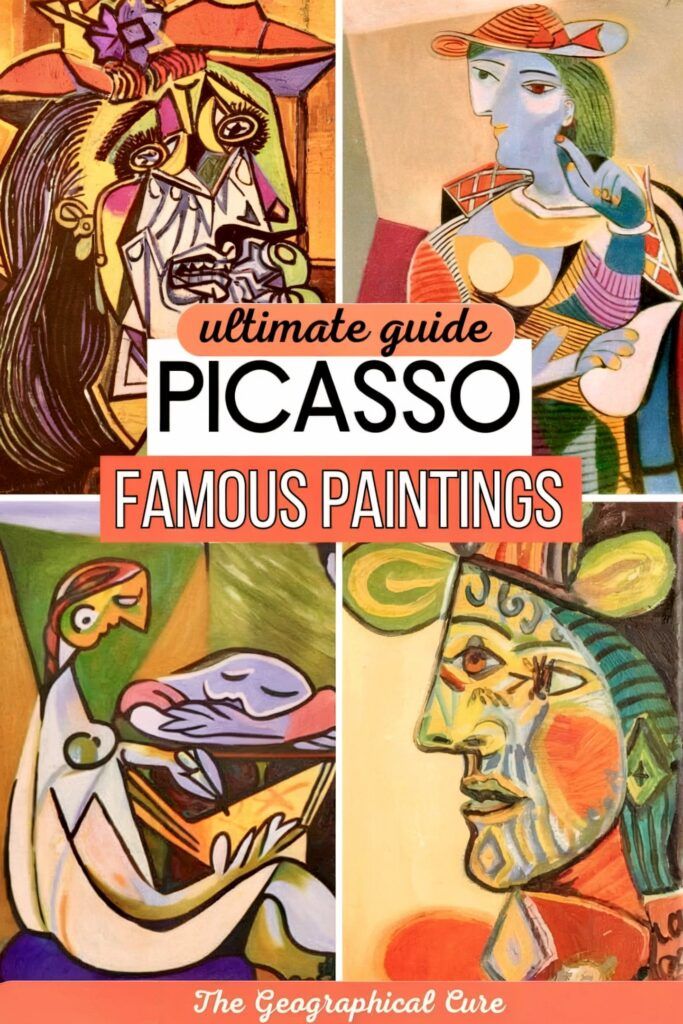
Pablo Picasso’s Famous Paintings
Pablo Picasso was one of the most influential artists of the twentieth century. Over a career spanning more than seven decades, he moved between styles, subjects and techniques, continually challenging the conventions of art. From the fragmented forms of Cubism to powerful images of war and grief, Picasso’s paintings remain among the most recognised in the world.
Here are some of his best-known works, along with the stories and ideas behind them.
Les Demoiselles d’Avignon (1907)
Often regarded as a landmark in the development of modern art, Les Demoiselles d’Avignon depicts five women in a brothel in Barcelona. Picasso breaks their bodies and faces into sharp, angular shapes, presenting them from several viewpoints at once. The work shocked many viewers and marked a decisive move away from traditional perspective. It also helped lay the groundwork for Cubism, the style Picasso developed with Georges Braque.
Guernica (1937)
One of Picasso’s most powerful paintings, Guernica responds to the bombing of the Basque town of Guernica during the Spanish Civil War. Painted in stark shades of black, white and grey, it shows people and animals caught in scenes of anguish and destruction. Rather than offering a straightforward account of the attack, Picasso uses fractured forms and expressive symbols to convey the suffering of civilians and the horror of war. The painting has since become an enduring anti-war image.
The Old Guitarist (1903–04)
Painted during Picasso’s Blue Period, The Old Guitarist shows a frail, seated musician holding a guitar. Cool blue tones dominate the composition, reinforcing its mood of poverty, isolation and sorrow. The guitar, painted in warmer brown shades, stands out against the figure’s elongated body. The work reflects Picasso’s interest in people living on the margins of society.
Girl before a Mirror (1932)
In Girl before a Mirror, a woman faces her reflection, but the two figures appear strikingly different. Bold colours and curved, patterned shapes transform the scene into something dreamlike. The painting is often associated with Picasso’s relationship with Marie-Thérèse Walter, who inspired many works from this period. Its contrasts invite questions about identity, self-image and the passage of time.
Three Musicians (1921)
Picasso painted two versions of Three Musicians in 1921, using the flat, sharply defined forms of Synthetic Cubism. The figures are dressed as characters from popular theatre: a harlequin, a pierrot and a monk. Their shapes fit together like pieces of a collage, while the musical instruments help distinguish each performer. The painting combines the structure of Cubism with a playful, theatrical subject.
The Weeping Woman (1937)
The Weeping Woman belongs to a series of paintings and drawings created in the aftermath of Guernica. Its subject is Dora Maar, the photographer and artist who was Picasso’s partner and a witness to the development of the mural. The woman’s face is rendered in jagged, overlapping shapes, with vivid colours intensifying her grief. The work is often seen as a more intimate counterpart to the suffering depicted in Guernica.
Le Rêve (1932)
Known in English as The Dream, this painting portrays Marie-Thérèse Walter resting in a chair. Picasso uses simple, flowing forms and bright colours, giving the scene a relaxed, sensual quality. Its apparent calm contrasts with the more turbulent mood of some of his other paintings from the 1930s. Le Rêve has also attracted attention for the private story behind its creation and its later history as a highly valued artwork.
A lasting influence
Picasso’s famous paintings reveal an artist who was never content to repeat himself. He reimagined the human figure, experimented with perspective and used colour and form to express emotion, memory and political ideas. Whether confronting the violence of war or exploring a quiet moment of reflection, his work continues to challenge and captivate audiences around the world.
Exploring Pablo Picasso: Fascinating Facts and His Most Famous Paintings
- What are 5 interesting facts about Pablo Picasso?
- What are Pablo Picasso’s five famous paintings?
- Why are Picasso paintings famous?
- What is one of Pablo Picasso’s most famous paintings?
- What is Pablo Picasso’s most popular painting?
- Where are Picasso’s most famous paintings?
- What was Picasso’s first painting?
- Did Pablo Picasso paint the Mona Lisa?
What are 5 interesting facts about Pablo Picasso?
Five interesting facts about Pablo Picasso are that he was born in Málaga, Spain, in 1881; his full baptismal name was exceptionally long; he took his mother’s surname, Picasso, rather than his father’s surname, Ruiz; he helped develop Cubism with fellow artist Georges Braque; and his painting Guernica became a powerful protest against the bombing of the Basque town during the Spanish Civil War. Picasso was also remarkably prolific, creating works in many different styles and across painting, sculpture, printmaking and ceramics.
What are Pablo Picasso’s five famous paintings?
There is no definitive list, but five of Pablo Picasso’s most famous paintings are Les Demoiselles d’Avignon (1907), which helped pave the way for Cubism; Guernica (1937), his powerful response to the bombing of a Basque town; The Old Guitarist (1903–04), a moving work from his Blue Period; Girl before a Mirror (1932), known for its vivid colours and fractured forms; and Three Musicians (1921), a striking example of Synthetic Cubism.
Why are Picasso paintings famous?
Picasso’s paintings are famous for their bold experimentation and lasting influence on modern art. He helped develop Cubism, transforming familiar subjects into fragmented forms shown from several viewpoints, and continually explored new styles, materials and ways of seeing. His works also tackle powerful themes, from personal emotion to the suffering of war, as seen in Guernica. This combination of artistic innovation, expressive force and wide-ranging subject matter has kept paintings such as Les Demoiselles d’Avignon and The Weeping Woman widely recognised and discussed.
What is one of Pablo Picasso’s most famous paintings?
One of Pablo Picasso’s most famous paintings is Guernica (1937), a monumental work inspired by the bombing of the Basque town during the Spanish Civil War. Painted in black, white and grey, it depicts the anguish and destruction caused by conflict. Its powerful imagery has made it an enduring symbol of the suffering of civilians and a widely recognised anti-war painting.
What is Pablo Picasso’s most popular painting?
Pablo Picasso’s most popular painting is often considered to be Guernica (1937), his monumental response to the bombing of the Basque town during the Spanish Civil War. Its stark monochrome palette, fractured figures and powerful depiction of suffering have made it one of the most recognised anti-war artworks in the world. Popularity is subjective, however, and other works—such as Les Demoiselles d’Avignon and The Weeping Woman—are also among his best-known paintings.
Where are Picasso’s most famous paintings?
Picasso’s most famous paintings are held in museums around the world. Guernica is at the Museo Reina Sofía in Madrid, while Les Demoiselles d’Avignon and Girl before a Mirror are in the collection of the Museum of Modern Art in New York. The Old Guitarist can be seen at the Art Institute of Chicago, Three Musicians at the Philadelphia Museum of Art, and The Weeping Woman at Tate Modern in London. Display arrangements can change, so it is worth checking each museum’s website before visiting.
What was Picasso’s first painting?
Picasso’s earliest known surviving painting is Le Picador (also known as The Little Yellow Picador), which he painted in 1889, aged about eight. The small work depicts a bullfighter in an arena and reflects the strong interest in bullfighting that would appear in his art throughout his life. It is generally described as his first known painting, rather than necessarily the very first picture he ever made.
Did Pablo Picasso paint the Mona Lisa?
No, Pablo Picasso did not paint the Mona Lisa. The famous portrait was painted by Leonardo da Vinci in the early 16th century, more than 300 years before Picasso was born. Picasso was, however, questioned during the 1911 theft of the painting from the Louvre, but he was later cleared of any involvement.