
Frida Kahlo’s Famous Paintings: Stories Behind the Art
Frida Kahlo (1907–1954) is remembered for vivid, emotionally direct paintings that draw on her own life, Mexican culture and the symbolism of nature. Many of her best-known works are self-portraits, but they are more than likenesses: they explore identity, love, pain, politics and the experience of living in a body marked by illness and injury.
Kahlo’s art is often associated with Surrealism, a movement interested in dreams and the unconscious. She resisted the label, saying that she painted her own reality. The paintings below offer an introduction to the recurring themes and striking imagery that made her work famous.
The Two Fridas (1939)
In The Two Fridas, two versions of Kahlo sit side by side, holding hands. Both wear dresses, but one is dressed in a European-style white gown while the other wears traditional Tehuana clothing. Their exposed hearts are joined by a vein, which is cut and held by surgical forceps in the hand of the white-dressed figure.
Painted around the time of Kahlo’s divorce from fellow artist Diego Rivera, the work is often read as an image of divided identity and emotional separation. It also suggests connection: despite their differences, the two figures remain physically linked. The large, stormy sky behind them intensifies the painting’s sense of unease.
Self-Portrait with Thorn Necklace and Hummingbird (1940)
This close-up portrait places Kahlo among dense foliage, with a monkey and a black cat behind her. A thorn necklace presses into her skin, while a lifeless hummingbird hangs from it. The contrast between the natural setting and the signs of pain gives the painting its unsettling power.
Animals and plants recur throughout Kahlo’s work, but their meanings are not fixed. The monkey has often been linked to Rivera, who gave Kahlo monkeys as pets, while the hummingbird has been interpreted in different ways, including as a symbol of hope or love. The image invites interpretation without offering a single, certain explanation.
Henry Ford Hospital (1932)
Henry Ford Hospital is among Kahlo’s most personal paintings. It shows her lying on a hospital bed after a miscarriage in Detroit, where Rivera was working on murals. Around her float objects connected by red, vein-like ribbons: a foetus, a medical instrument, a pelvis and other forms.
The stark, empty landscape makes the bed appear isolated. Rather than turning the experience into a conventional scene of sorrow, Kahlo presents it through a series of intimate and sometimes unsettling images. The painting is also notable for its candour about reproductive loss, a subject rarely represented so openly in art at the time.
Self-Portrait with Cropped Hair (1940)
In this self-portrait, Kahlo sits in a chair wearing an oversized dark suit. Her long hair has been cut short and scattered across the floor. A line of music and Spanish lyrics at the top of the painting reads, “Look, if I loved you, it was for your hair. Now that you are without hair, I don’t love you any more.”
The work was made in the aftermath of Kahlo and Rivera’s separation. By presenting herself in clothing associated with men and removing a feature closely tied to her public image, she challenges expectations about femininity and appearance. Her expression remains composed, making the scene feel less like a simple act of heartbreak than a deliberate statement of independence.
The Broken Column (1944)
The Broken Column depicts Kahlo’s torso split open to reveal a fractured architectural column in place of her spine. Metal supports surround her body, and nails pierce her skin. Tears run down her face as she looks directly at the viewer.
The image is connected to the severe physical pain Kahlo experienced after a bus accident in her youth and to the medical treatments she underwent throughout her life. The cracked landscape behind her echoes the damage represented within her body. The painting is painful to look at, yet Kahlo’s direct gaze gives the figure a powerful presence.
What the Water Gave Me (1938)
In What the Water Gave Me, Kahlo’s legs and feet emerge from a bath while a collection of images appears on the water’s surface. Small scenes of people, buildings, plants and a volcano mingle with references to memory, desire and mortality.
Rather than presenting a single narrative, the painting resembles a visual stream of thought. Its unusual viewpoint and layered imagery show how Kahlo could turn personal memories and cultural references into a complex, dreamlike composition.
Diego and I (1949)
Diego and I is one of Kahlo’s best-known later self-portraits. Rivera’s face appears on her forehead, with a third eye between his brows, while strands of her hair tighten around her neck. Kahlo’s eyes are wet with tears, and she looks straight out at the viewer.
The painting expresses the intensity of Kahlo’s attachment to Rivera, but it also suggests the strain that relationship placed upon her. By placing his image within her own, she makes visible the way love, identity and emotional distress can become entangled.
Why Frida Kahlo’s paintings still matter
Kahlo’s paintings remain compelling because they bring private experience into public view without simplifying it. Her work explores physical suffering, cultural identity, relationships and self-presentation with remarkable honesty. Bold colour and carefully chosen symbols sit alongside direct, sometimes uncomfortable imagery.
Her self-portraits are not simply records of how she looked. They are acts of storytelling: each costume, animal, plant and gesture helps shape the person she presents to the world. That combination of personal detail and open-ended symbolism continues to draw new viewers to her art.
Unveiling Frida Kahlo: Exploring Symbolism in Her Most Iconic Paintings
- Look for the joined hearts in *The Two Fridas* (1939).
- In *Self-Portrait with Thorn Necklace and Hummingbird*, notice the thorn necklace and animals.
- *The Broken Column* shows Kahlo’s pain through a cracked column and nails.
- *Henry Ford Hospital* reflects Kahlo’s miscarriage and isolation.
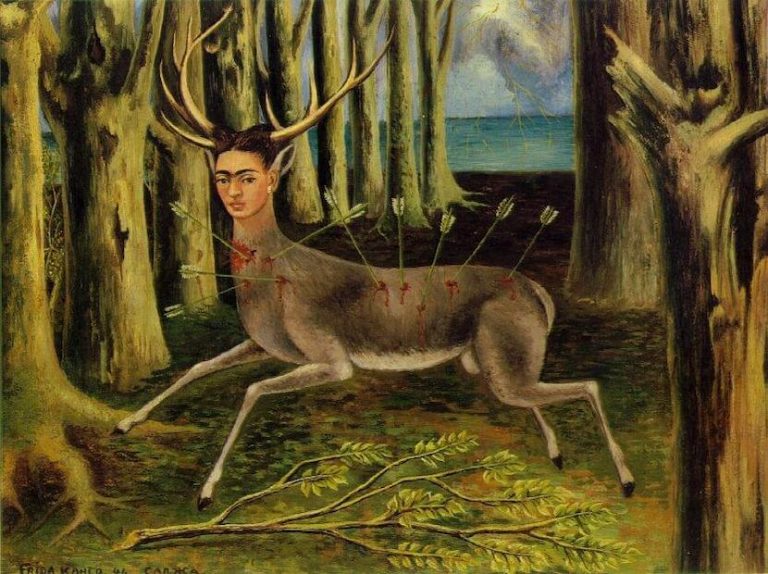
- In *The Wounded Deer*, Kahlo portrays herself as a wounded stag.
Look for the joined hearts in *The Two Fridas* (1939).
In Frida Kahlo’s The Two Fridas (1939), look closely at the two figures’ exposed hearts: a thin vein connects them, linking the women despite their contrasting clothes and appearance. This striking detail can be read as a symbol of shared identity and emotional attachment, while the cut vein hints at heartbreak and separation.
In *Self-Portrait with Thorn Necklace and Hummingbird*, notice the thorn necklace and animals.
In Self-Portrait with Thorn Necklace and Hummingbird, look closely at the thorn necklace and the animals surrounding Kahlo. The thorns press into her skin, creating a striking image of pain, while the monkey and black cat add a sense of mystery to the dense foliage. These details invite you to consider how nature, suffering and symbolism come together in one of her most memorable self-portraits.
*The Broken Column* shows Kahlo’s pain through a cracked column and nails.
In The Broken Column, Frida Kahlo gives striking visual form to the physical pain she endured after a serious accident. Her torso is split open to reveal a cracked column in place of her spine, while nails pierce her skin and tears run down her face. The stark imagery conveys her suffering, yet her steady gaze also suggests resilience in the face of it.
*Henry Ford Hospital* reflects Kahlo’s miscarriage and isolation.
Henry Ford Hospital reflects Frida Kahlo’s experience of miscarriage and the profound isolation she felt afterwards. Painted in 1932, it shows her alone on a hospital bed in a stark, industrial landscape, surrounded by symbolic objects linked by red, vein-like ribbons. Its unflinching imagery makes the painting a deeply personal expression of grief and physical suffering.
In *The Wounded Deer*, Kahlo portrays herself as a wounded stag.
In The Wounded Deer (1946), Frida Kahlo portrays herself as a wounded stag, pierced by arrows and standing alone in a dense forest. The animal’s face is Kahlo’s own, blending human identity with nature to express vulnerability, physical suffering and resilience. Despite its injuries, the stag remains upright, while the broken tree and distant glimpse of water add to the painting’s atmosphere of isolation. The work is often connected to Kahlo’s lifelong health problems, though its symbolism remains open to interpretation.